


Nature Notes: Mammals Checklist - Bison at Kankakee Sands

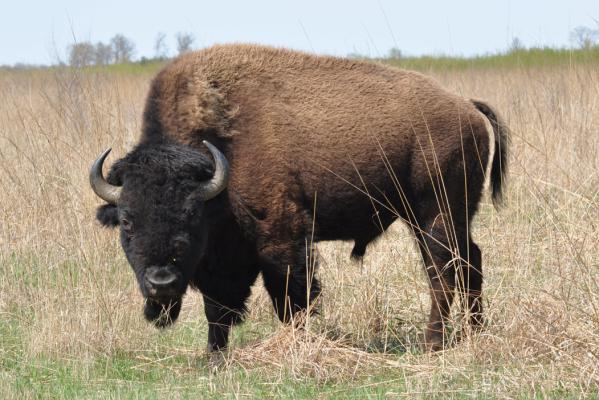
Photo by Rick Katz A visit to Kankakee Sands this time of the year may afford you the majestic view of a male bull bison weighing in at 1500 pounds, or maybe a very young bison calf weighing a mere 55 pounds. Although bison rightly dominate the landscape, they’re not the only mammals at Kankakee Sands. Not by a long shot. Believe it or not, you can find 33 different mammals of varying shapes and sizes on our Kankakee Sands prairies and savannas…

Read More

Nature Notes: Pearly Whites - Bison's Grazing Habits

Bison have been grazing the prairies at Kankakee Sands for two and a half years now, and I still find them as intriguing and fascinating as the first day they arrived. Those stately thousand-pound beasts seem to calmly pass the day, but actually they are very hard at work…with their teeth! The bison’s grazing habits are why we brought them to Kankakee Sands —to help rejuvenate our prairies by eating the grasses and sedges, allowing the flowering plants to thrive. More flowering plants means a more diverse prairie, which in turn attracts a greater variety of birds, insects and animals. And those 32 teeth of the bison have been putting a world of hurt on scouring rush, one of our more challenging invasive plant species at Kankakee Sands…

Read More

Where There’s a Willow, There’s a Way at Kankakee Sands

Photo by Jeff Timmons I was standing out in a 400-acre wet prairie just north of our Kankakee Sand office, placidly harvesting seeds when I hear the crackling, sizzling Zzzzap! like the sound of an electrical circuit shorting out. With exactly zero electric lines running through that particular prairie, what could have made that sound? Then I noticed a large willow patch… and where there is a willow patch at Kankakee Sands, there may be a sedge wren (Cistothorus platensis) singing its electrical sounding song. …

Read More

Nature's Surprises - Bison Calf Born in November

“Hey, whattaya know, we got ourselves a cinnamon!” April and May are the typical calving months for our Kankakee Sand bison. So, you can imagine our utter shock and surprise when we saw a little red bison calf in the pasture this past November! The first question that comes to mind is, “How did that happen?!” Well, we know how it happened. The better question may be, “Why did that happen?”…

Read More

Planting All the Way to the Sky! Indiana Native Plants

Photo: Aphrodite butterflies on butterfly weed by Gus Nyberg My mailbox is starting to fill with seed catalogs. Even though it is only February, my mind is already dreaming of a well weeded garden, overflowing with the ripest of fruit and not a garden pest within 40 miles. Oh! And I just know that this year my landscaping of native flowers and shrubs will bloom all through the spring, summer and fall, with nary a weed to be found. Sigh…maybe someday. …

Read More

Nature Notes: Thankful for Fungus at Kankakee Sands

It’s iffy whether or not you’ll see a wild turkey during a walk in the woods at this time of year. But it’s a surefire bet that you will see the striking, turkey tail fungus. For that, I’m always grateful. Turkey tail, Trametes versicolor, is one of the most common fungi growing on the sides of logs or trees.  It is a stalkless mushroom, called a shelf fungus, which looks much like a fan with scalloped edges…

Read More

Decorating the Prairie - Garden Spiders at Kankakee Sands

Halloween decoration is in full swing. Ghosts, witches, and spiders are popping up everywhere. The prairies of Kankakee Sands seem decorated for the upcoming holiday too. All around are spider webs that glitter with the dew on these chilly fall mornings. The most common spider that I see at Kankakee Sands during the months of September and October is Argiope aurantia, otherwise known as yellow and black garden spider, corn spider, zipper spider, writing spider, or black and yellow argiope…

Read More

Nature Notes: Tall Coreopsis Flowers - Dancing Butter?

Photo credit: Tall coreopsis with an orange sulfur butterfly, taken by Jeanette Jaskula. Yellow does for September what orange does for October. It makes you feel that all is well and right, and that summer is coming to a close. The end-of-summer prairie is filled with many different hues of yellow. My favorite yellow is that of tall coreopsis ( Coreopsis tripteris ), now in bloom at Kankakee Sands…

Read More

Honk is the Call of the Wild | Canada Geese

When I was a youngster, few things brought thoughts of wild lands and far off places into my head than hearing and seeing a Vee-shaped skein of Canada geese winging their way south in the fall or heading back to their summering area in the springtime. If I was lucky, I’d witness this majesty two or three times each year. Nowadays, seeing a Canada goose is almost as common as seeing robins in a yard or gulls along the lakefront…

Read More